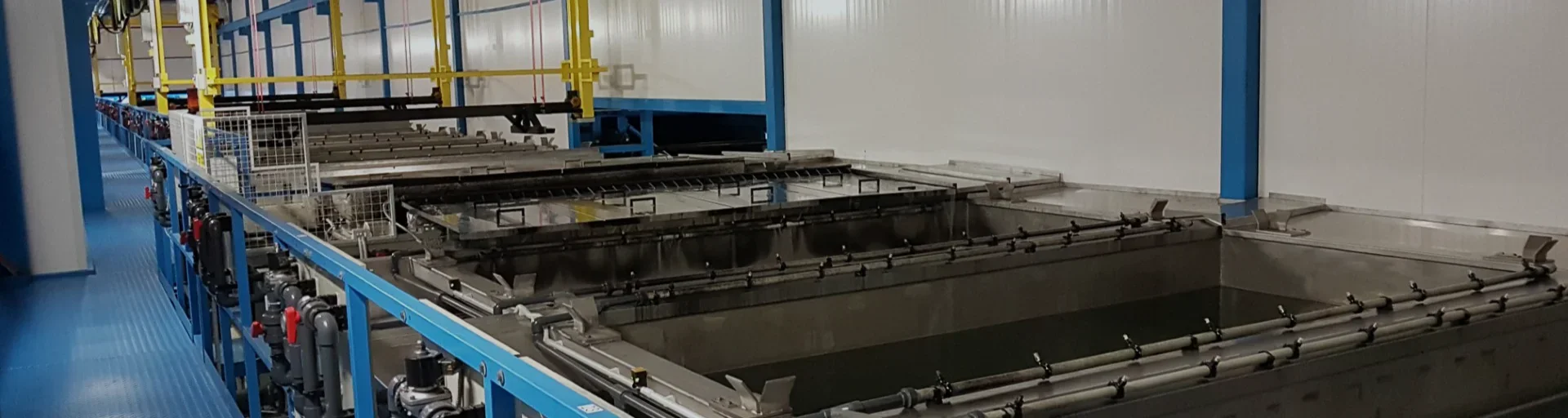
One Technology. Thousands of Paint Shops.
You would find MEGA-TEC membranes in the cataphoretic lines of every leading automotive brand worldwide. A key component of cathodic dip coating technology is the direct current power supply, which is the only driving force of the paint deposition process. The requirements for its parameters can generally be summarized by the voltage range provided, which in most cases is from 50 to 350 V. Approximately 10 to 15 A per square meter can be calculated. Another essential part of the process is the anolyte circuit, which stabilizes the pH of the immersion bath. In practice, it consists of several anolyte boxes immersed in the coating tank, a circulation tank with a pump, and piping distribution systems. During operation, the anolyte solution must be circulated through the boxes in a volume corresponding to their size and design type, typically 150 to 500 litres per hour per box.
Why cathodic dip coating remains a proven technology
Cathodic dip coating provides sufficient protection already at a layer thickness of 18 to 35 micrometers. It also delivers high corrosion resistance at low EC coating thickness, approximately 25 µm / 1000 h salt spray test. Other key benefits include:
- excellent EC base,
- outstanding uniformity of the deposited layer.
These characteristics are why e-coating remains one of the most widely used and trusted surface treatment technologies across automotive and other industrial paint shops.
Main types of electrophoretic cells
Electrophoretic cells (EFC) can be divided into the following categories:
- Tubular cells with welded d81 mm membrane
- Tubular cells with extruded d65 mm membrane
- Flat and semicircular cells
Each design has its own technical features and its own area of use depending on the line layout and application.
Tubular cells with d81 mm welded membrane: RALEX® Membrane AM8HD
This is the most popular type of electrophoretic cell. The design of the top head enables the required circulation of the anolyte, with inlet in the centre of the anode and side or top outlet. The d81 mm diameter membrane is installed around the anode by fitting it onto a perforated plastic tube made of PP. The perforated tube defines the space between the membrane and the electrode for effective anolyte flow. The tubular anode is made of stainless steel 316Ti as standard in welded design, with seamless stainless steel or titanium available as an option. It is positioned inside the EFC with a diameter of 60.3 mm. The standard thickness is 3 mm, with 6.3 mm available as an option. The design also allows free rotation of the anode. The bottom cap is designed to guarantee the required tightness of the entire system and the areas for wall fixing. Its length is 75 mm.
Advantages of this most popular type
- 4-year guarantee for the membrane part
- Membrane surface enables easy cleaning, as paint flows smoothly down from the membrane
- Membrane can be dried after cleaning
- Lower electrical resistance
- EFC holder for first deliveries
- Mechanical stability
- No need to use an outer grid
- No need for brush cleaning
- Lower thickness, approximately three times thinner, with higher electrical resistance and permselectivity than extruded membrane
- Membrane developed for 21st century paints
- Higher anodic area and better paint adaptation due to lower swelling difference
- Ability to produce membranes compatible with competitor original electrodes
- Ability to produce other spare parts such as electrodes, connectors, holders, and other components
- Ability to provide complete installation and service
Tubular cells with d65 extruded membrane: RALEX® Membrane AM-XT
The design of the top head enables the required circulation of the anolyte, with inlet in the centre of the anode and side or top outlet. The tubular membrane is installed around the anode by fixing it in the bottom cap and top head.
The tubular anode is made of stainless steel 316Ti as standard in seamless design, with titanium available as an option. It is positioned inside the EFC with a diameter of 44.5 mm and a standard thickness of 2 mm. The design also allows free rotation of the anode.
The bottom cap design also ensures the required tightness of the entire system and wall fixing areas. Its length is 65 mm. Extruded membranes are suitable for use in narrow e-coat lines, such as radiators or furniture applications, rather than in automotive or agricultural applications.
Flat and semicircular cells with flat RALEX® Membrane AM5HD
MEGA-TEC produces flat and semicircular cells in widths from 300 to 850 mm and lengths from 850 to 4000 mm. The top part of the cell includes cell hangers, anolyte inlet and outlet, and electrical connection. The body material is PVC-U, with PP available as an option. The frame also serves as mechanical support and is made of PVC-U.
The ion-exchange membrane in flat sheet form is stretched between the anode and the frame. It is fixed around the perimeter using suitable O-ring sealing and screws. The flat anode is positioned inside the cell. The standard material is stainless steel AISI 316Ti, with titanium available as an option. The membrane surface allows easy cleaning without any mechanical brush, as paint flows smoothly down from the membrane.
Why cell design matters in practice
The design of the electrophoretic cell affects more than installation alone. It also influences anolyte flow, ease of cleaning, maintenance demands, compatibility with existing equipment, and the long-term stability of the coating process. In practice, the right EFC design helps support:
- Stable pH conditions in the bath
- Reliable paint deposition
- Easier maintenance and cleaning
- Better adaptation to specific line geometry
- Compatibility with existing electrodes and spare parts strategy
The choice between welded tubular, extruded tubular, and flat or semicircular designs depends on the type of line, the available space, and the specific requirements of the coating application.
European e-coat membrane production
MEGA-TEC is the only producer of e-coat membrane in Europe. This gives customers direct access to membrane production know-how combined with the design and supply of electrophoretic cells, compatible spare parts, and technical support for cataphoretic coating lines.
Looking for the right EFC solution for your line?
Whether you are planning a retrofit, replacing existing cells, or looking for a design adapted to your line geometry, MEGA-TEC can help you find the right solution.
Get in touch with our team to discuss your application, required cell type, and compatibility with your current system.
18. 3. 2026


